CMMI, or the Capability Maturity Model Integration, is a widely recognized framework for helping organizations improve their processes, performance, quality, and business outcomes. One of the most commonly searched questions about CMMI is: “What are the 5 levels of CMMI?”
The five CMMI maturity levels provide a structured path for organizations to improve from unpredictable and reactive processes to highly optimized and continuously improving operations.
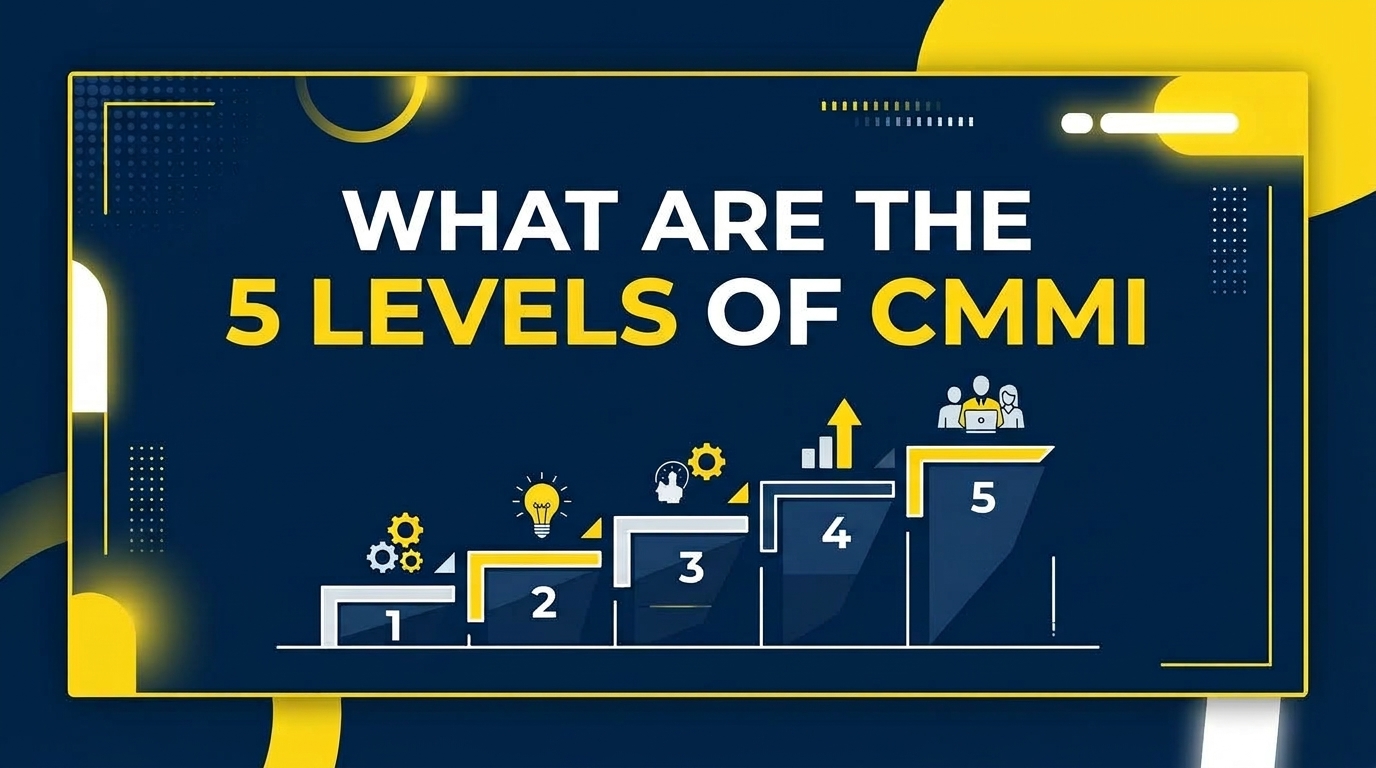
The five CMMI maturity levels are:
-
Level 1 – Initial
-
Level 2 – Managed
-
Level 3 – Defined
-
Level 4 – Quantitatively Managed
-
Level 5 – Optimizing
Each maturity level represents a different stage of organizational process maturity. Moving from one level to another requires stronger processes, better management practices, greater measurement, and a more systematic approach to continuous improvement.
This guide explains each CMMI level, what it means, how organizations progress through the levels, and why CMMI maturity can be valuable for businesses operating in software development, IT services, cybersecurity, engineering, supplier management, and other process-driven industries.
What Is CMMI?
Capability Maturity Model Integration (CMMI) is a process improvement framework designed to help organizations understand their current capabilities, identify areas for improvement, establish effective processes, and improve business performance.
CMMI can be applied across different organizational activities and industries. Depending on the organization's needs, relevant CMMI models and domains can address areas such as development, services, security, suppliers, and virtual work.
CMMI is particularly relevant for organizations that want to improve process consistency, manage operational risks, improve quality, increase predictability, and demonstrate disciplined business practices.
An important distinction is that CMMI is not the same as an ISO certification. CMMI uses appraisals to evaluate process implementation and organizational performance against the applicable CMMI model and appraisal requirements.
What Are the 5 Levels of CMMI?
The five CMMI maturity levels describe a progression of organizational process maturity:
-
CMMI Level 1 – Initial: Processes are unpredictable and reactive.
-
CMMI Level 2 – Managed: Projects or work activities are planned, performed, measured, and controlled.
-
CMMI Level 3 – Defined: Standard processes are established at the organizational level and tailored where appropriate.
-
CMMI Level 4 – Quantitatively Managed: Processes are measured and controlled using quantitative objectives and data.
-
CMMI Level 5 – Optimizing: The organization continuously improves its processes and performance using quantitative understanding, innovation, and optimization.
Let's look at each level in more detail.
CMMI Level 1 – Initial
CMMI Level 1 is called Initial.
At Level 1, an organization may be able to deliver products and services, but its processes are generally unpredictable and reactive. Success can depend heavily on individual employees, experience, or efforts made during a particular project.
There may be processes in place, but they are not necessarily consistently implemented across the organization.
For example, one project team may follow a particular approach to software development, while another team uses a completely different approach. Documentation, planning, measurement, risk management, and quality practices may vary significantly between projects.
Characteristics of CMMI Level 1
Organizations operating at an Initial level may experience:
- Unpredictable project outcomes
- Inconsistent processes
- Reactive problem-solving
- Dependence on individual expertise
- Difficulty predicting schedules and costs
- Inconsistent quality
- Limited process measurement
- Recurring operational problems
- Difficulty managing organizational risks systematically
Level 1 does not necessarily mean that an organization cannot deliver successful projects. Rather, it indicates that processes and outcomes are not sufficiently predictable or standardized.
Example of Level 1
Imagine a software company managing five projects.
Each project manager uses a different project management method. Documentation requirements vary. Testing practices differ between teams. Some risks are documented while others are handled informally.
The company may successfully complete projects, but it may struggle to consistently predict delivery dates, costs, quality, and project performance.
This is characteristic of an Initial environment.
CMMI Level 2 – Managed
CMMI Level 2 is called Managed.
At Level 2, organizations introduce greater discipline into project and work management.
Projects are planned, performed, measured, and controlled. The organization begins establishing repeatable management practices that make project execution more predictable.
The focus at this level is primarily on managing individual projects or work activities effectively.
Characteristics of CMMI Level 2
A Level 2 organization generally focuses on:
- Project planning
- Requirements management
- Project monitoring and control
- Measurement and analysis
- Quality management
- Configuration management
- Supplier-related management where applicable
- Risk and issue management
- Establishing commitments
- Tracking project performance
The organization has a better understanding of what needs to be done, who is responsible, how progress will be monitored, and how problems should be addressed.
Why Level 2 Matters
Moving from Level 1 to Level 2 is an important step because the organization begins replacing reactive management with disciplined project management.
Instead of relying primarily on individual experience, project teams begin using established management practices.
Example of Level 2
Consider the same software company.
Instead of every project manager working differently, project teams now create project plans, define requirements, track schedules, monitor costs, manage changes, and measure project performance.
Management can review project status and identify problems before they become major failures.
This represents a significant improvement over an Initial environment.
CMMI Level 3 – Defined
CMMI Level 3 is called Defined.
At Level 3, the organization moves beyond project-level management and establishes standardized processes at the organizational level.
This is one of the most important differences between Level 2 and Level 3.
At Level 2, processes are managed primarily at the project level.
At Level 3, the organization establishes and maintains a set of standard processes that can be used across different projects and business activities.
Characteristics of CMMI Level 3
A Defined organization typically has:
- Organization-wide standard processes
- Documented procedures and guidelines
- Defined process assets
- Organizational process management
- Process training
- Standardized workflows
- Tailoring guidelines
- Consistent quality practices
- Better organizational knowledge management
- More systematic process improvement
The goal is not necessarily to force every project to operate identically.
Instead, the organization establishes standard processes that provide a common foundation. Individual projects can tailor those processes according to their specific requirements while maintaining organizational consistency.
Why Level 3 Is Important
Level 3 can be particularly valuable for organizations that have multiple teams, departments, projects, locations, or customers.
As an organization grows, relying on individual employees to determine how work should be performed becomes increasingly difficult.
Defined organizational processes create a common operating framework.
Example of Level 3
A technology company develops an organization-wide software development process.
The process defines how requirements are managed, how development activities are performed, how testing is conducted, how changes are controlled, how project performance is monitored, and how lessons learned are captured.
Different projects may tailor the process according to their needs, but they operate within the organization's defined process framework.
That is the fundamental concept behind the Defined level.
CMMI Level 4 – Quantitatively Managed
CMMI Level 4 is called Quantitatively Managed.
At Level 4, organizations take process management to a more advanced level by using quantitative measurement and analysis to understand and control process performance.
The organization is no longer simply asking:
“Are we following the process?”
It is also asking:
“What does the data tell us about how well the process is performing?”
This distinction is important.
Characteristics of Level 4
A Quantitatively Managed organization focuses on:
- Quantitative objectives
- Statistical and quantitative analysis
- Process performance measurement
- Predictability
- Performance baselines
- Data-driven management
- Variation analysis
- Quantitative process control
- Performance trends
Management decisions are increasingly supported by reliable performance data rather than assumptions or opinions.
Example of Level 4
Suppose a software organization tracks historical data for:
- Defect rates
- Development productivity
- Testing performance
- Delivery timelines
- Rework
- Customer requirements
- Project performance
Over time, the organization establishes quantitative expectations for process performance.
If a project begins showing unusual performance variation, management can identify the issue using data and take corrective action.
The objective is greater predictability and control.
CMMI Level 5 – Optimizing
CMMI Level 5 is called Optimizing.
Level 5 represents the highest maturity level in the five-level CMMI maturity model.
At this stage, the organization focuses on continuous improvement and optimization.
The organization uses quantitative understanding of process performance to identify opportunities for improvement, address root causes, improve performance, and introduce beneficial innovations.
Characteristics of Level 5
A Level 5 organization focuses on:
- Continuous process improvement
- Root-cause analysis
- Preventing recurring problems
- Process optimization
- Innovation
- Performance improvement
- Data-driven improvement
- Identifying improvement opportunities
- Organizational learning
- Long-term business performance
The objective is not simply to maintain existing processes.
The organization continuously asks:
“How can we make this process better?”
Example of Level 5
Imagine an organization has years of process performance data.
The organization identifies recurring causes of software defects, analyzes the reasons behind them, introduces process improvements, measures the results, and determines whether the improvement generated measurable benefits.
The organization continues this cycle of analysis, improvement, measurement, and optimization.
This continuous improvement mindset is central to Level 5.
CMMI Levels 1 to 5 at a Glance
The five maturity levels can be summarized as follows:
-
Level 1 – Initial
Processes are unpredictable and reactive.
-
Level 2 – Managed
Projects and work activities are planned and controlled.
-
Level 3 – Defined
Standard organizational processes are established and consistently applied.
-
Level 4 – Quantitatively Managed
Processes are measured and controlled using quantitative data.
-
Level 5 – Optimizing
The organization continuously improves and optimizes its processes.
A simple way to remember the progression is:
Initial → Managed → Defined → Quantitatively Managed → Optimizing
What Is the Difference Between CMMI Level 2 and Level 3?
This is one of the most common CMMI questions.
The key difference is the scope of process definition.
At Level 2, the organization focuses on managing projects effectively.
At Level 3, the organization establishes standard processes at the organizational level.
For example:
-
Level 2:
“Our project has a defined project plan and follows controlled processes.”
-
Level 3:
“Our organization has standard processes that provide a common framework for multiple projects.”
Therefore, Level 3 represents a broader level of organizational process institutionalization.
What Is the Difference Between CMMI Level 3 and Level 4?
The primary difference is the use of quantitative management.
At Level 3, an organization has defined and standardized processes.
At Level 4, the organization uses quantitative objectives and data to understand and control process performance.
In simple terms:
- Level 3 = Defined processes
- Level 4 = Defined processes + quantitative control and predictability
An organization at Level 4 should have a much stronger ability to understand process performance using data.
What Is the Difference Between CMMI Level 4 and Level 5?
Level 4 focuses heavily on quantitative management and predictability.
Level 5 builds on this foundation by emphasizing continuous improvement and optimization.
In simple terms:
- Level 4: Measure and control performance.
- Level 5: Use that understanding to continuously improve and optimize performance.
Both levels require a strong measurement culture, but Level 5 adds a stronger focus on sustained improvement and innovation.
Is CMMI Level 5 Better Than Level 3?
A higher maturity level generally represents a more advanced stage of organizational process maturity.
However, the “best” level depends on the organization's objectives, business environment, customer expectations, contractual requirements, and improvement goals.
Not every organization needs to pursue Level 5.
For many organizations, establishing strong and repeatable processes at Level 2 or Level 3 may provide substantial business value.
Organizations with mature measurement systems and a strategic need for highly predictable and continuously optimized processes may pursue higher maturity levels.
The appropriate objective should be business improvement, rather than pursuing a maturity level simply for the label.
How Does a CMMI Appraisal Relate to the Five Levels?
A CMMI appraisal evaluates an organization's process implementation against the applicable CMMI model and appraisal requirements.
A Benchmark Appraisal can provide an organizational rating associated with a maturity level when the applicable requirements are met.
The appraisal process is not simply an audit of documents.
It involves evaluating how processes are implemented and how the organization performs against the relevant CMMI practices and appraisal requirements.
Organizations should therefore prepare by understanding the applicable CMMI model, defining appropriate processes, implementing those processes, maintaining evidence of implementation, and ensuring personnel understand their responsibilities.
CMMI Maturity Levels and Business Improvement
The five maturity levels can help organizations establish a structured improvement journey.
The progression can be viewed as:
- Level 1 → Establish stability
- Level 2 → Manage projects
- Level 3 → Standardize organizational processes
- Level 4 → Manage performance quantitatively
- Level 5 → Continuously optimize
This progression can be especially useful for organizations operating in environments where consistency, quality, security, delivery performance, customer satisfaction, and operational predictability are important.
Who Can Benefit From CMMI Maturity Improvement?
CMMI can be relevant to organizations across different industries and operating models.
Depending on the applicable CMMI model or domain, organizations may include:
- Software development companies
- IT service providers
- Technology companies
- Cybersecurity organizations
- Engineering organizations
- Digital service providers
- Service-based businesses
- Supplier and procurement organizations
- Organizations with distributed or virtual teams
- Businesses serving international customers
For organizations working with large enterprises or international customers, demonstrating mature and systematic processes can also support confidence in organizational capability.
CMMI V3.0 and Maturity Levels
Organizations considering CMMI should pay attention to the applicable CMMI V3.0 model and current appraisal requirements.
CMMI V3.0 provides updated models and appraisal approaches intended to help organizations improve performance and demonstrate capability.
The exact practices and requirements applicable to an organization depend on the relevant CMMI model or domain and the scope of the appraisal.
Organizations should therefore avoid treating the five maturity levels as a standalone checklist. Proper CMMI implementation requires understanding the applicable model, organizational context, appraisal scope, and evidence requirements.
CMMI Maturity Levels vs Capability Levels
Another important point is that maturity levels and capability levels are not the same thing.
CMMI maturity levels range from:
Capability levels are different and can range from:
- Capability Level 0 to Capability Level 3
Maturity levels represent a staged path of organizational process improvement.
Capability levels focus on the performance and improvement of specific practice areas.
Understanding this distinction is important when discussing CMMI appraisal results.
How Can an Organization Progress Through the CMMI Levels?
An organization should not approach CMMI as simply trying to collect documentation.
A more effective approach is to connect process improvement with actual business objectives.
A typical improvement journey may involve the following steps:
-
Understand the Business Objectives
Identify why the organization wants to improve.
Objectives may include:
- Improving delivery predictability
- Reducing defects
- Improving customer satisfaction
- Managing operational risks
- Strengthening cybersecurity processes
- Improving supplier management
- Increasing process consistency
-
Determine the Appropriate CMMI Scope
The organization should determine which CMMI model or domain is relevant to its business objectives.
For example, organizations may consider CMMI-DEV, CMMI-SVC, CMMI-SEC, CMMI-SPM, or CMMI-VRT depending on their needs and appraisal scope.
-
Assess the Current State
A gap assessment can help identify differences between current organizational practices and applicable CMMI expectations.
-
Improve Processes
The organization can establish or improve processes, roles, responsibilities, documentation, measurements, and implementation practices.
-
Implement the Processes
Processes must be implemented in real organizational work rather than existing only as documents.
-
Collect Evidence and Performance Data
Organizations should maintain appropriate evidence demonstrating that processes are being implemented and managed.
-
Conduct the Appropriate Appraisal
Once the organization is adequately prepared, it can proceed with the applicable CMMI appraisal.
-
Continue Improving
CMMI should not be treated as a one-time exercise. The long-term objective should be sustainable process and business performance improvement.
Why Do Organizations Pursue Higher CMMI Maturity?
Organizations may pursue CMMI maturity improvement for several reasons.
-
Better Process Consistency
Standardized processes can reduce unnecessary variation between teams and projects.
-
Improved Predictability
More mature processes can help organizations improve their ability to understand and predict performance.
-
Better Quality
Structured processes can support improved quality management and defect prevention.
-
Stronger Risk Management
Systematic process management can help organizations identify and address risks more effectively.
-
Improved Customer Confidence
A structured approach to process improvement can demonstrate that the organization takes operational performance and process maturity seriously.
-
Continuous Improvement
Higher maturity encourages organizations to use measurement, analysis, and organizational learning to improve performance over time.
Common Misunderstandings About CMMI Levels
There are several misconceptions about CMMI that organizations should avoid.
CMMI Is Not Simply a Documentation Exercise
Having procedures and documents does not automatically mean an organization operates at a particular maturity level.
Actual process implementation matters.
CMMI Level 5 Does Not Mean Perfect
Level 5 does not mean that an organization has no problems.
It represents a mature environment focused on continuous improvement and optimization.
Higher Is Not Always the Immediate Goal
Organizations should select improvement objectives that make sense for their business.
CMMI Is Not the Same as ISO Certification
CMMI and ISO standards have different structures, purposes, terminology, and assessment or appraisal approaches.
CMMI maturity should therefore not be described as an ISO-style certification.
CMMI Consulting and Benchmark Appraisal Services
Organizations that want to improve their CMMI maturity may work with experienced consultants and appraisal service providers.
CMMI consulting can help organizations understand their current process maturity, identify gaps, establish improvement plans, strengthen implementation, and prepare for an applicable appraisal.
B-ADVANCY Certification Limited provides CMMI consulting and appraisal-related services covering selected CMMI V3.0 domains, including:
- CMMI for Development (CMMI-DEV) V3.0 Benchmark Appraisal
- CMMI for Services (CMMI-SVC) V3.0 Benchmark Appraisal
- CMMI for Security (CMMI-SEC) V3.0 Benchmark Appraisal
- CMMI for Suppliers (CMMI-SPM) V3.0 Benchmark Appraisal
- CMMI for Virtual (CMMI-VRT) V3.0 Benchmark Appraisal
Organizations should determine the appropriate model and appraisal scope based on their business objectives and applicable requirements.
Final Thoughts: Understanding the 5 Levels of CMMI
So, what are the 5 levels of CMMI?
They are:
- Level 1 – Initial
- Level 2 – Managed
- Level 3 – Defined
- Level 4 – Quantitatively Managed
- Level 5 – Optimizing
Together, these levels describe a progression from unpredictable and reactive processes toward standardized, measurable, predictable, and continuously improving organizational performance.
The most important point is that CMMI should not be viewed simply as a maturity-level target. The real value comes from using structured process improvement to achieve meaningful business outcomes.
Whether an organization is beginning its process improvement journey at Level 1, establishing project discipline at Level 2, standardizing processes at Level 3, strengthening quantitative management at Level 4, or pursuing continuous optimization at Level 5, the objective should remain the same: better processes, better performance, and sustainable business improvement.
If your organization is considering CMMI V3.0 implementation, consulting, or a Benchmark Appraisal, start by defining your business objectives and determining which CMMI model and appraisal scope are appropriate for your organization.
Frequently Asked Questions About the 5 CMMI Levels
-
What are the 5 levels of CMMI?
The five CMMI maturity levels are Initial, Managed, Defined, Quantitatively Managed, and Optimizing. They represent progressive stages of organizational process maturity.
-
What is CMMI Level 1?
CMMI Level 1, Initial, represents an environment where processes are generally unpredictable and reactive. Successful results may depend significantly on individual effort and experience.
-
What is CMMI Level 2?
CMMI Level 2, Managed, focuses on planning, performing, measuring, and controlling projects or work activities using disciplined management practices.
-
What is CMMI Level 3?
CMMI Level 3, Defined, means the organization has established standard organizational processes that provide a consistent foundation across projects and activities.
-
What is CMMI Level 4?
CMMI Level 4, Quantitatively Managed, focuses on using quantitative objectives, measurement, and analysis to understand and control process performance.
-
What is CMMI Level 5?
CMMI Level 5, Optimizing, focuses on continuous improvement, root-cause analysis, innovation, and optimization of organizational processes and performance.
-
Is CMMI Level 5 the highest level?
Yes. Level 5 is the highest maturity level in the five-level CMMI maturity structure.
-
Is CMMI Level 3 better than Level 2?
Level 3 represents a higher stage of organizational maturity than Level 2 because it establishes standard organizational processes rather than focusing primarily on managing individual projects.
-
Is CMMI a certification?
CMMI uses appraisal terminology rather than treating maturity as an ISO-style certification. Organizations undergo applicable CMMI appraisals to evaluate process implementation and determine relevant appraisal results or ratings.
-
Can a company move directly to CMMI Level 5?
Organizations should consider the applicable CMMI model, appraisal requirements, business objectives, and current process maturity when planning their improvement journey. A maturity-level strategy should be based on actual organizational needs and sustainable process improvement.
📞 WhatsApp:Chat on WhatsApp📧 Email:info@b-advancy.com


 Contact For Services
 Explore Training Calendar